
DIY Halloween costumes work best when you treat them as a small design problem, not a shopping trip. Start with clothes you already own, choose one recognizable signature detail, and decide how much sewing you actually want to do. The sources behind this guide show the same pattern repeatedly: a solid base outfit plus ears, a sign, a prop, or a bold lip reads as a costume in seconds. That approach keeps costs down, makes the look removable for work or school, and often produces something more durable than a one-night store-bought outfit. If you are short on time, the last-minute Halloween costumes DIY approach covers fast closet-based looks, while group planners can use the DIY group Halloween costumes coordination guide to keep a whole squad visually consistent.
Why DIY Halloween Costumes Are Worth Making
The case for making DIY Halloween costumes is practical before it is creative. Heather Handmade's costume roundup notes that reusing fabric and clothing from a stash saves money and time, and the author says her own homemade costumes have used stronger, more durable fabric than store-bought versions, lasting through months of dress-up rather than one night of trick-or-treating. That durability matters if you have children who return to the same characters again and again.
A second reason is climate. The same source points out that in cold areas, a costume planned around warm layers means a child does not have to wear a coat over the whole look. A sweatshirt-based Bluey or Bingo costume, for example, keeps the character recognizable while staying warm.
DIY also solves the late-October problem. Raising Arizona Kids frames last-minute costumes around regular clothes, simple accessories, and things already in a closet, explicitly avoiding overnight shipping, a sewing machine, or an evening covered in hot glue. The result does not have to be a big production. A flannel shirt, construction paper, and a junk-drawer prop can be enough.
Finally, DIY costumes are easier to make work-appropriate. Ashlin Akaposta's work-costume guide recommends building every costume on top of regular work clothes so it can be put together in about 15 minutes and taken off in seconds. That removability is hard to buy. If you want to go further, the DIY group Halloween costumes coordination guide shows how the same closet-first approach scales to a whole squad.
Tips
- Check the weather forecast before committing to a thin or heavily layered costume.
- Keep a small box of reusable props, ears, and fabric scraps from year to year.
- Photograph each finished costume so you can rebuild it quickly next year.
Start With Your Closet, Not the Store
The strongest recurring instruction across the sources is to begin with what you already own. Ashlin Akaposta puts it directly: start with your closet, not the store, and pull out every solid-colored piece, especially black, white, denim, and anything bright. Most costumes start with a solid base. Raising Arizona Kids makes the same point before suggesting any purchase: check closets first, and remember that most costumes are recognizable with just two or three things, not every accessory on a list.
A practical closet audit looks like this: separate solid tops, dark trousers, denim, a dress or two, and any bright or unusual piece you rarely wear. Then look for outerwear, hats, scarves, and shoes that could carry a character. GQ's last-minute costume gallery builds almost every idea from clothes already owned, adding only the odd cheap prop. A black suit becomes Jules Winnfield; a yellow Hawaiian shirt and sunglasses become Cliff Booth; a baker boy cap does most of the identifying work for Tommy Shelby.
Once you have a base, decide what is missing. Often it is one small item: cat ears, a bandana, a lanyard, or a sign. That is the moment to check a dollar store or drugstore rather than order a full costume. The goal is to spend on the detail that makes the look read, not on replacing clothes you already have. If you are assembling DIY Halloween costumes at the last minute, the last-minute Halloween costumes DIY approach walks through fast closet-based looks.
Materials
- Solid-colored tops in black, white, denim, or one bright color
- Dark trousers or jeans
- A dress or skirt that can serve as a base
- Hats, scarves, and outerwear already in the closet
- Shoes that suit the character
The One-Signature-Detail Rule
A costume reads clearly when it has one recognizable element: ears, a sign, a prop, or a bold lip. Ashlin Akaposta calls this picking one signature detail and notes that you do not need ten pieces. Raising Arizona Kids applies the same logic, saying most costumes are recognizable with just two or three things.
The rule is useful because it prevents overbuilding. If you are going as a black cat, the ears and whiskers are enough; a tail made from an old black sock is optional. If you are a farmer, a straw hat and a stuffed animal do the work; overalls are nice but jeans are fine. If you are a tourist, a baseball cap, fanny pack, and camera are sufficient.
Choosing the signature detail also helps with work and school costumes. A removable detail, such as a sash, a headband, or a sign, can be taken off in seconds if you need to look professional again. The detail should be quick to explain, too. The best office costumes get a laugh in one sentence, such as "I'm a smart cookie."
When you are deciding between two details, pick the one that is most visible from a distance and easiest to remove. That usually means something worn on the head or held in the hand rather than something attached to the main garment.
Tips
- Test the costume from across a room: if the signature detail is not obvious, make it larger or bolder.
- Keep the detail removable so the base outfit can return to normal use.
- Avoid adding a second strong detail that competes with the first.
No-Sew and Low-Sew Techniques
Not every DIY Halloween costume requires a sewing machine. Heather Handmade's collection includes both sewn and no-sew costumes, and several ideas rely on felt, sweatshirts, and simple accessories. A Bluey or Bingo costume, for example, is built from a sweatshirt and felt. A raccoon costume is described as comfortable, easy to make, and wearable as a regular set afterward.
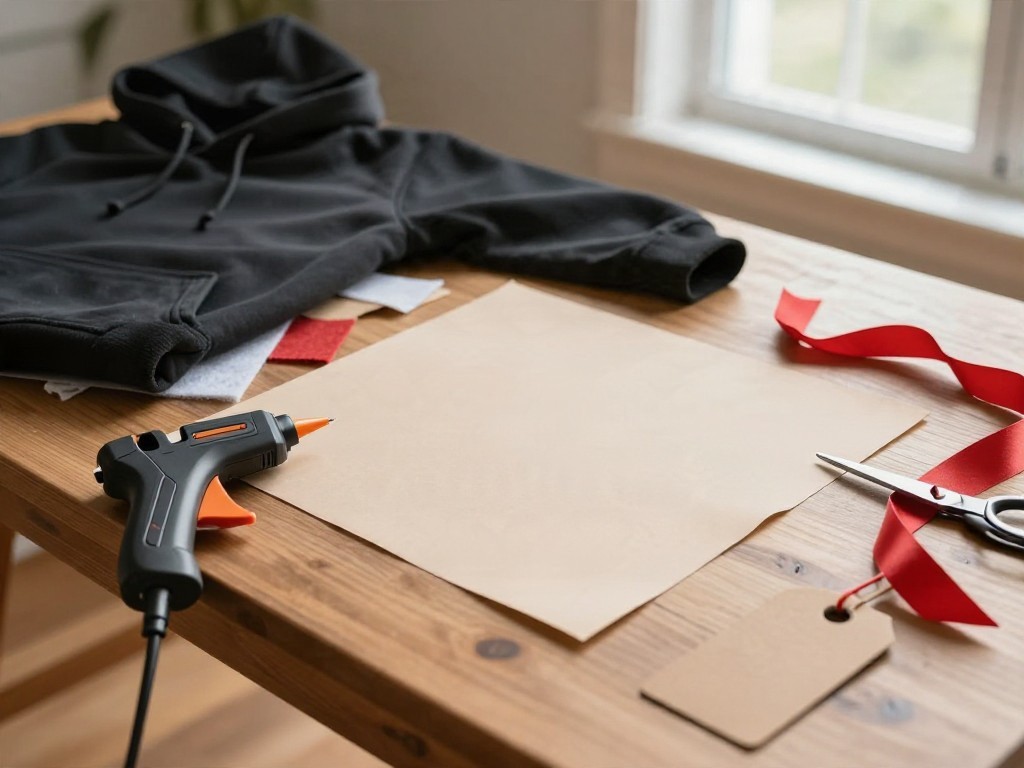
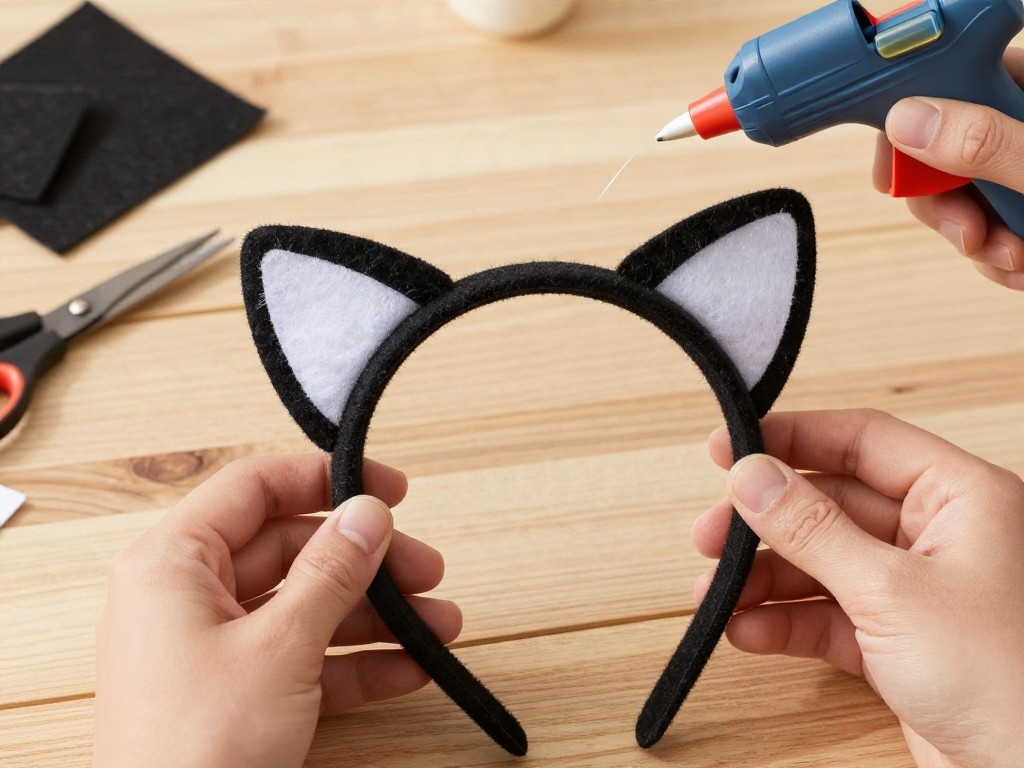
Hot glue appears in several of the cited no-sew examples. Good Housekeeping's 90s-inspired costume attaches cut felt ears to a hoodie with hot glue and uses red cardstock and ribbon for a heart-shaped tag. The jewelry-box ballerina costume uses hot glue for a faux drawer, oversized bows, beads, and gemstones, and duct tape to secure a ribbon strap inside the box. The Crocs costume uses hot glue to attach a cardboard strap and backpack-style straps made from thick ribbon.
Low-sew projects sit in between. A free costume robe sewing pattern can produce a Jedi or Harry Potter robe, and a free hat pattern can make a Frankenstein head. These are optional upgrades, not requirements. If you do not sew, choose a no-sew version of the same character and rely on the signature detail.
Safety note: hot glue and craft knives are tools for adults or supervised older children. The sources describe using an X-Acto knife or box cutter to cut cardboard, which requires care and a stable cutting surface.
Tools
- Hot glue gun and glue sticks
- Duct tape or packing tape
- Scissors
- X-Acto knife or box cutter for cardboard (adult use)
- Cutting mat or scrap cardboard
Steps
- Lay out the base garment and the detail pieces before gluing anything.
- Mark where the detail should sit while the garment is being worn or held at the right height.
- Apply hot glue to whichever surface suits the materials, and press firmly until set.
- Reinforce load-bearing joins, such as straps, with duct tape or stitching.
- Let glue cool completely before trying the costume on.
Last-Minute Costumes for Kids
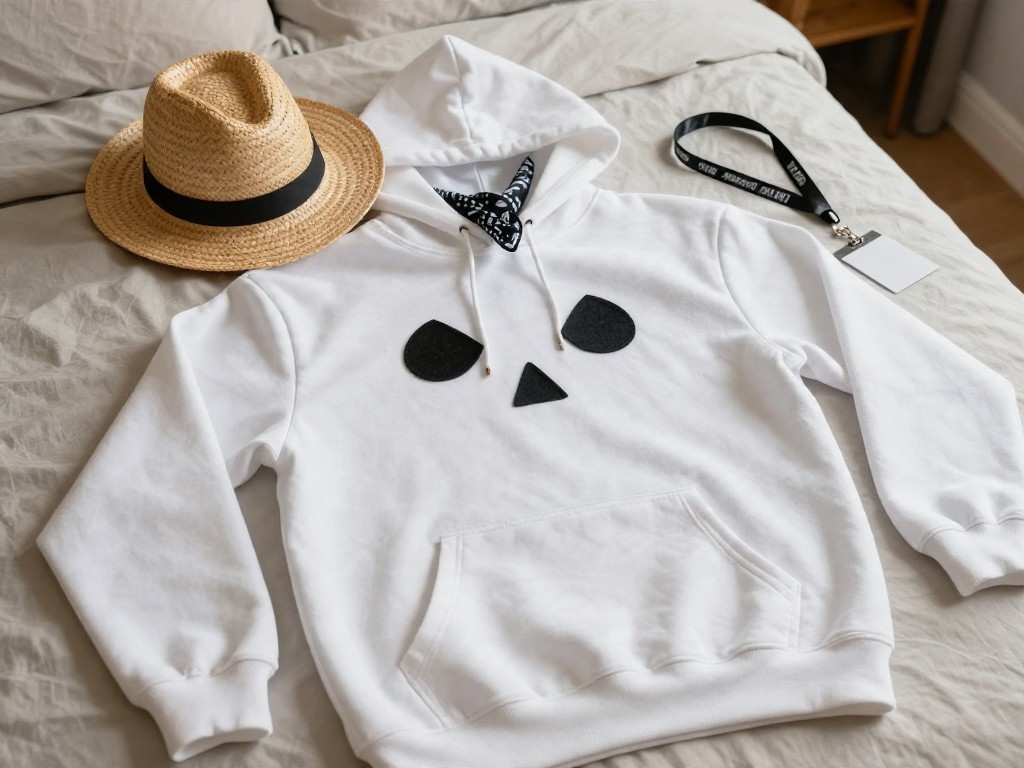
Last-minute kids' costumes work best when they use regular clothes and one or two accessories. Raising Arizona Kids lists 40 options built from closet items, and the patterns repeat: a black cat needs ears on a headband and whiskers; a ghost can be a white hoodie with black felt eyes; a cowboy needs a hat, bandana, and boots; a lumberjack is basically winter clothing plus an optional washable makeup beard.
Several ideas are especially quick. An 80s workout instructor needs bright clothes, a scrunchie, a sweatband, or leg warmers, and mismatched colors are a bonus. A rock star needs messy hair, costume jewelry, and a toy microphone or guitar if available. A ballerina can use dance-class supplies or a leotard, tights, and a skirt if there is no tutu. A teacher costume needs a lanyard, pencils, and a notebook or clipboard.
For younger children, the source advises skipping the classic sheet ghost if they will be running in the dark; a white hoodie with black felt eyes is offered as an easier-to-see alternative. Also check the toy bin before buying anything: a toy hard hat and tool belt can make a construction worker, and a dish towel or paper chef's hat can make a chef or baker.
The goal is not a big production. If you are pulling a costume together the night before with a flannel shirt, construction paper, and a junk-drawer find, that works.
Materials
- Headband and black cardstock or felt for cat ears
- White hoodie and black felt for a ghost
- Straw hat, bandana, and boots for a cowboy
- Bright clothing, scrunchie, and sweatband for an 80s instructor
- Lanyard, pencils, and notebook for a teacher
Tips
- Skip long sheets or trailing fabric for children who will be walking in the dark.
- Use washable face paint and test it on a small area first.
- Keep accessories soft and lightweight so they stay on.
Work- and School-Appropriate Costumes
Work and school costumes have a different brief: you need to sit, walk, and work in them, and you may need to remove the costume quickly. Ashlin Akaposta's guide sets out clear criteria. The costume should let you type, drive, or do school pickup. No masks that cover the face, because many offices and almost every school ban them. Coverage should match your normal dress code: if you would not wear the hemline or neckline on a regular Tuesday, do not wear it on Halloween. Nothing gory, political, or culturally insensitive, and no fake weapons or blood.
The one-signature-detail rule is especially useful here. A "Copy Cat" costume is a white T-shirt that says "COPY" plus cat ears. A smart cookie can be a simple sign or a bold lip. The detail should be quick to explain and easy to remove if a client meeting appears.
Build the costume on top of your regular work clothes so it can be put together in about 15 minutes and taken off in seconds. That usually means choosing a base outfit you would wear anyway, then adding a headband, a sash, a sign, or a lanyard. If you need to look professional again, the costume disappears with one or two removals.
Check your workplace or school policy before the day, especially for face paint and headwear. When in doubt, choose the more restrained version. If you are still assembling DIY Halloween costumes the night before, the last-minute Halloween costumes DIY guide covers fast closet-based options.
Tips
- Avoid face-covering masks and heavy face paint.
- Choose a costume you can sit and type in without adjustment.
- Keep the removable detail in a bag or desk drawer once the event is over.
Couples and Group Costume Ideas
Group costumes work when each person follows the same base-plus-detail formula and the group agrees on one shared visual cue. Heather Handmade's collection includes a DIY Gru and Lucy couple costume described as no-sew, and a Queen of Hearts costume that can be customized. GQ's gallery offers a ready-made two-person Street Fighter option: one white gi and red headband for Ryu, one red gi and black belt for Ken, with dressing gowns and belts as substitutes if karate gear is unavailable.
For couples, the strongest ideas are often simple clothing combinations. A Superman look can be a blue top, red pants, and a red cape, with a plain blue top and homemade chest badge if there is no Superman T-shirt. Jason and Lucia from Grand Theft Auto 6 can be a printed Hawaiian shirt over a white tee, chinos, and a cap for him, and a crop top, denim shorts, and gold hoops for her.
For larger groups, decide on a shared color palette or a repeated prop before assigning individual details. The DIY group Halloween costumes guide covers coordination in more depth. Keep each person's costume removable and comfortable, and make sure the group cue is visible in photos.
If you are also decorating, the easy Halloween DIY decorations guide can help tie the setting to the costumes without adding another shopping trip.
Tips
- Agree on one shared color or prop so the group reads as a unit.
- Let each person choose a comfortable base outfit rather than matching exact garments.
- Test the group look in a photo before the event.
Adapting Costumes for Cold Weather
Group costumes work when each person follows the same base-plus-detail formula and the group agrees on one shared visual cue. Heather Handmade's collection includes a DIY Gru and Lucy couple costume described as no-sew, and a Queen of Hearts costume that can be customized. GQ's gallery offers a ready-made two-person Street Fighter option: one white gi and red headband for Ryu, one red gi and black belt for Ken, with dressing gowns and belts as substitutes if karate gear is unavailable.
For couples, the strongest ideas are often simple clothing combinations. A Superman look can be a blue top, red pants, and a red cape, with a plain blue top and homemade chest badge if there is no Superman T-shirt. Jason and Lucia from Grand Theft Auto 6 can be a printed Hawaiian shirt over a white tee, chinos, and a cap for him, and a crop top, denim shorts, and gold hoops for her.
For larger groups, decide on a shared color palette or a repeated prop before assigning individual details. The DIY group Halloween costumes guide covers coordination in more depth. Keep each person's costume removable and comfortable, and make sure the group cue is visible in photos.
If you are also decorating, the easy Halloween DIY decorations guide can help tie the setting to the costumes without adding another shopping trip.
Adapting DIY Halloween Costumes for Cold Weather
Cold-weather planning is a design decision, not an afterthought. One costume maker who lives in a cold area says she always plans costumes to be warm so kids don't have to wear a jacket or coat over the finished look. That is the practical goal: build warmth into the costume itself so the recognizable silhouette survives the weather.
Start with the base layer, not the costume. The closet-first approach behind most last minute Halloween costumes DIY builds every look on a solid-colored base outfit. In cold weather that base can simply be a long-sleeve tee, tights, leggings or a thermal layer in the costume's main color. A black cat, an '80s workout instructor or a lumberjack all read clearly over warm underlayers because the identifying detail sits on top.
Choose costumes whose signature element is a layer you can add rather than a garment you must replace. The work-and-school formula of one solid base plus one signature detail — ears, a hat, a sign, a bold lip — translates directly to cold weather. A hoodie with felt ears hot-glued on, as in a 90s-style costume, is warmer than a thin headband and keeps the character readable. A sweatshirt-and-felt approach used for character costumes like Bluey and Bingo does the same job.
Where the source costumes rely on exposed skin, swap in a warmer equivalent rather than abandoning the idea. A cowboy or cowgirl costume works with the bandana and boots doing most of the identifying, so a long-sleeve shirt underneath changes little. A ballerina look can sit over tights. An artist costume can be an old long-sleeve shirt with washable paint marks.
Treat outerwear as part of the costume where possible. A dark coat over a waistcoat-style look, or a worn-in gilet and wax jacket for a country-clothes character, are costume pieces in their own right. If a coat must go over everything, keep the identifying detail — hat, ears, prop, makeup — on the outside or easily re-applied.
Avoid the sheet ghost for young children running around in the dark, as one source advises; a white hoodie with black felt eyes is the warmer, safer-reading alternative. Check that added layers still let the wearer sit, walk and use their hands, and that nothing dangles near a flame or trips at the hem.
Mistakes to watch: layering so heavily the character disappears, choosing a costume whose only cue is bare skin, and adding a coat that hides the one detail that made the costume work. Decide the warm base first, then attach the signature detail on top. For a whole squad braving the cold together, the DIY group Halloween costumes coordination guide shows how to keep a shared look consistent.