
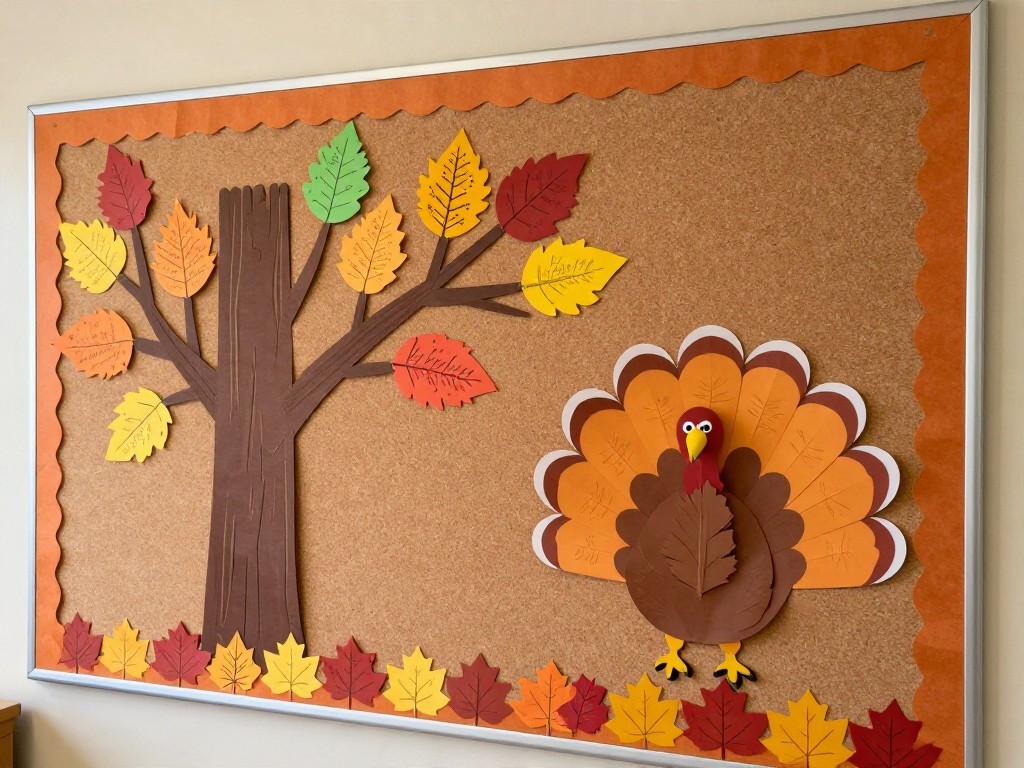
Thanksgiving bulletin boards in November give you a flexible display that can be pure decoration or a working part of your classroom. The sources behind this guide show boards built around gratitude, turkeys, harvest colors, reading, math, and student participation. Use the sections below to choose a theme, plan the assembly order, and avoid the common mistakes that make a board look busy without doing any teaching. For a related seasonal project outside the classroom, the Thanksgiving table decor practical guide covers a different reader task: setting a table rather than building a wall display.
Why Thanksgiving Bulletin Boards in November Matter
A November bulletin board sits in an awkward spot on the school calendar. The start-of-year buzz has faded, and the winter holidays are still weeks away. The sources describe this gap as a reason to make the board both seasonal and useful rather than purely decorative. A Thanksgiving board can reinforce vocabulary, give student writing a real audience, and mark the season without requiring a full holiday unit.
The strongest examples in the sources share three traits. First, they have a clear title or saying that tells viewers what the board is about. Second, they include student-made pieces, so the display changes as the month goes on. Third, they connect to something already happening in the room, such as a read-aloud, a math unit, or a gratitude routine. A board that only looks festive is fine, but a board that collects student work gives you a reason to keep it up through the month.
Plan for the board to be assembled in stages. Put up the background, border, and title first, then add student pieces as they are finished. This staged approach matches the interactive boards described in the sources, where the display grows fuller over time. It also means you are not trying to finish everything in one prep period.
Before you commit to a theme, check what the board will hold. A gratitude tree needs room for many leaves. A turkey feather board needs a large turkey body with space around the tail. A word wall needs a grid or clear rows. Measure the available space and decide whether the board is a single focal display or a background for ongoing additions. That decision will shape every later choice, from title length to the size of student cutouts.
Tips
- Put up the background, border, and title before adding student work.
- Choose a theme that connects to a lesson or routine already in your schedule.
- Measure the board first so the title and student pieces fit without crowding.
Gratitude and Thankfulness Displays
Gratitude is the most common Thanksgiving board theme in the sources, and it is also the easiest to make interactive. The Thankful Tree is the clearest example: a large trunk and branches, with leaves cut in fall colors, and each student writing things they are thankful for on a few leaves. The leaves attach to the branches, and the tree fills in as the class adds to it. Small acorns or woodland animals around the base are optional decoration.
A second approach is the "I'm Thankful For" turkey, where each feather carries a statement of thanks. This works well when you want a single focal image rather than a tree. A third option is a photo board titled "We Are Thankful," with leaf cutouts carrying student names and a sentence starter such as "I'm thankful for…" A class photo in the center anchors the display, and blank leaves in a pocket let students and families add more during the month.
For older students, the sources suggest a weekly prompt board titled "Attitude of Gratitude," where peers add compliments, or a "Thankful for Community" board that tracks a service project or food drive with a progress bar. These versions keep the gratitude theme but shift the audience from self-reflection to community action.
Decide how students will contribute before the board goes up. Will each student write on a leaf during a morning routine, or will the leaves be a center activity? Will the writing be dictated for younger students, or independent? The sources show dictated sentences used with young children, which keeps the board accessible without turning it into a lengthy writing assignment. Keep the sentence starter visible on the board so students who finish early can add a second leaf without asking for instructions.
Materials
- Large paper or fabric for the tree trunk and branches
- Leaf cutouts in orange, yellow, red, and brown
- Markers or pencils for student writing
- Optional acorns or small woodland animal cutouts
Steps
- Build the trunk and branches on the board first.
- Cut leaves in fall colors and give each student a few.
- Have students write what they are thankful for on the leaves.
- Attach the leaves to the branches as students finish.
- Add optional acorns or animals around the base.
Turkey-Themed Thanksgiving Bulliten Boards November
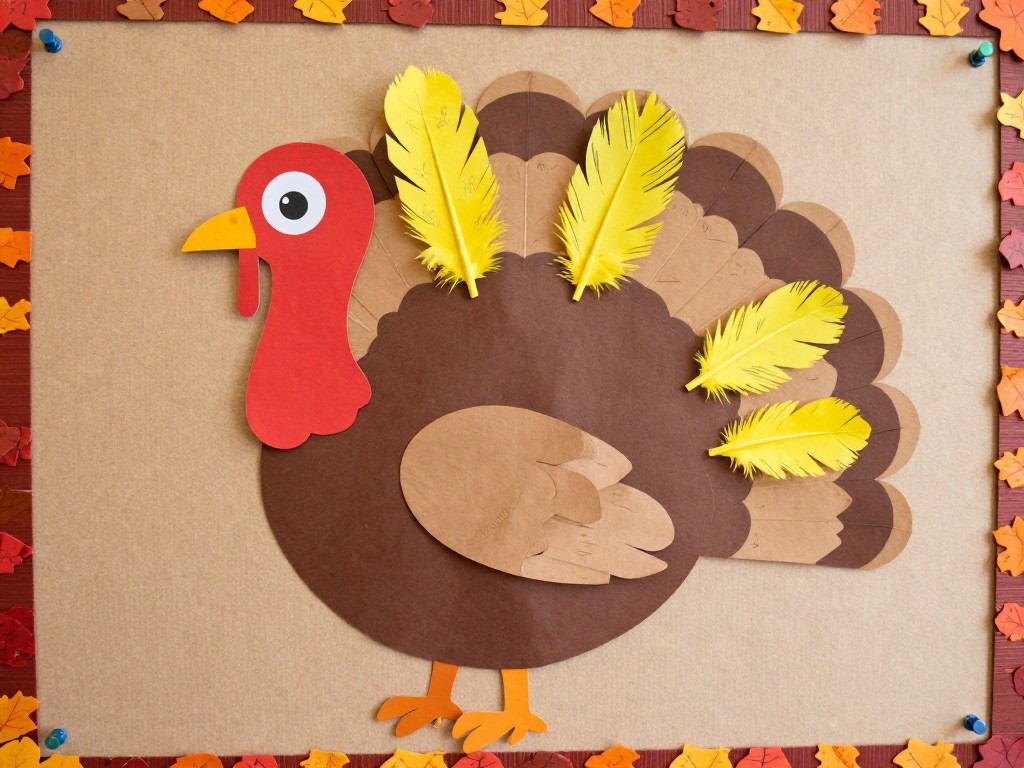
Turkey boards are the most recognizable November display, but the sources show several ways to make them more than a cartoon. The simplest is a large turkey body without tail feathers. Each student receives a feather cutout and writes one kind act they did or plan to do, then attaches it to the turkey. The tail grows fuller as the class adds feathers, and the board becomes a record of shared kindness. Titles such as "Feathers of Kindness" or "Spread Kindness, One Feather at a Time" make the purpose clear.
A behavior-focused version is "Fatten Ole Tom," where students add a feather each time they demonstrate good behavior or submit homework on time. This turns the board into a visible progress tracker, though it works best when the criteria are clear and every student can earn feathers regularly.
For a content tie-in, the "Build a Sentence Turkey" uses a paper plate as the body, stapled so the top half forms a pocket. Feathers are labeled with words from different parts of speech, such as nouns, verbs, and adjectives. Students pull feathers from the categories to create sentences. This is a more complex build, but it keeps the turkey theme connected to grammar work.
A persuasive writing version pairs a read-aloud of "Twas the Night Before Thanksgiving" with student writing that argues for something other than turkey on the holiday table. The finished writing can be published on a turkey craft and displayed. This option takes longer because it includes drafting and revision, so plan it as a multi-day project rather than a single board assembly.
Choose the turkey version that matches your available time. The kindness feather board can be assembled in a single session. The sentence-building turkey needs laminated feathers and a pocket body. The persuasive writing board needs several days of writing instruction before anything goes on the wall. For a related seasonal project outside the classroom, the Thanksgiving table decor practical guide covers setting a table rather than building a wall display.
Materials
- Large turkey body cutout
- Feather cutouts in bright colors
- Paper plate for a pocket-style turkey body
- Markers for feather labels
Steps
- Attach the turkey body to the board.
- Prepare feathers for each student or each word category.
- Have students write or choose their feather content.
- Attach feathers to the turkey as they are completed.
Tips
- Keep the feather criteria visible so students know what to write.
- For a pocket turkey, staple only the bottom half of the plate so the top stays open.
Fall and Harvest Visual Themes
Harvest and fall color themes give you a board that works for the whole month, not just the week of Thanksgiving. The sources describe boards built around leaves, pumpkins, baskets, and warm colors. A harvest-themed reading board, for example, uses the title "Fall Into a Good Book" or "Our Top Class Books Harvest," with colorful leaves, pumpkins, and baskets of "harvested" books. Each student recommends a book on a small paper pumpkin or leaf.
A shades-of-meaning board takes a different angle. Students choose a fall color word and look up more vivid versions, then write the stronger word on a leaf cutout. The leaves hang around the classroom or on the board. This connects the visual theme to vocabulary work and gives the board a clear language arts purpose.
A favorite-season opinion writing board uses a tree craft that students decorate to match their chosen season. The finished trees go on a fall bulletin board or in the hallway. This is a longer project because it includes brainstorming and drafting, but the display is entirely student-made.
When building a harvest board, decide whether the visual elements are decoration or student work. Pre-made leaves and pumpkins can fill space quickly, but student-written pieces give the board more meaning. A mix works well: a few large decorative elements anchor the display, and student pieces fill the rest. Keep the color palette limited to fall tones so the board reads as one display rather than several unrelated projects. For a related seasonal project outside the classroom, the Thanksgiving table decor practical guide covers setting a table rather than building a wall display.
Tips
- Limit the palette to orange, yellow, red, brown, and a neutral background.
- Use a few large decorative elements to anchor the board, then fill with student work.
- Choose a title that names the theme so viewers understand the display at a glance.
Literacy and Book Recommendation Boards
Reading-themed boards are a natural fit for November because they can run alongside existing read-alouds and independent reading. The harvest book board described above is one example. A simpler version is a "Gratitude Book Reviews" corner where students post mini reviews of fall or Thanksgiving books. This works in a library corner or a classroom reading area and can be as simple as index cards on a bordered section of the board.
A "Gobble Up Good Books" title works well for a display of student recommendations. Each student writes a short recommendation on a turkey or leaf cutout and attaches it to the board. The board becomes a peer recommendation wall that other students can browse during independent reading time.
For a read-aloud connection, the persuasive turkey writing project pairs a specific book with a writing task. The finished writing goes on the board, so the display shows both the reading and the writing that came from it. This is a stronger literacy tie-in than a decorative board because the student work is the centerpiece.
Keep the writing task short enough that the board fills within a reasonable time. A sentence or two per student is enough for a recommendation board. Longer reviews work better as a separate writing assignment with a smaller number of displayed pieces. Decide whether every student will contribute or whether students will add to the board as they finish books during the month.
Tips
- Keep recommendation cards short so the board fills quickly.
- Place the board near the classroom library or reading corner.
- Leave blank cards available so students can add recommendations throughout the month.
Literacy and Thanksgiving Bulliten Boards November Book Recommendations
Reading-themed boards are a natural fit for November because they can run alongside existing read-alouds and independent reading. The harvest book board described above is one example. A simpler version is a "Gratitude Book Reviews" corner where students post mini reviews of fall or Thanksgiving books. This works in a library corner or a classroom reading area and can be as simple as index cards on a bordered section of the board.
A "Gobble Up Good Books" title works well for a display of student recommendations. Each student writes a short recommendation on a turkey or leaf cutout and attaches it to the board. The board becomes a peer recommendation wall that other students can browse during independent reading time.
For a read-aloud connection, the persuasive turkey writing project pairs a specific book with a writing task. The finished writing goes on the board, so the display shows both the reading and the writing that came from it. This is a stronger literacy tie-in than a decorative board because the student work is the centerpiece.
Keep the writing task short enough that the board fills within a reasonable time. A sentence or two per student is enough for a recommendation board. Longer reviews work better as a separate writing assignment with a smaller number of displayed pieces. Decide whether every student will contribute or whether students will add to the board as they finish books during the month. For a related seasonal project outside the classroom, the Thanksgiving table decor practical guide covers a different reader task: setting a table rather than building a wall display.
Materials
- Word cards or sentence strips for a word wall
- Turkey body and feather cutouts for a fraction board
- Laminated whiteboard strip and dry-erase marker
- Sticky tack or push pins
Steps
- Choose the academic focus: vocabulary, fractions, or trivia.
- Prepare the board background and title.
- Add the reference materials, such as word cards or fraction labels.
- Set up the interactive elements, such as movable feathers or flip cards.
- Explain the routine for using the board during the month.
Math and Vocabulary Tie-In Boards for Thanksgiving Bulliten Boards November
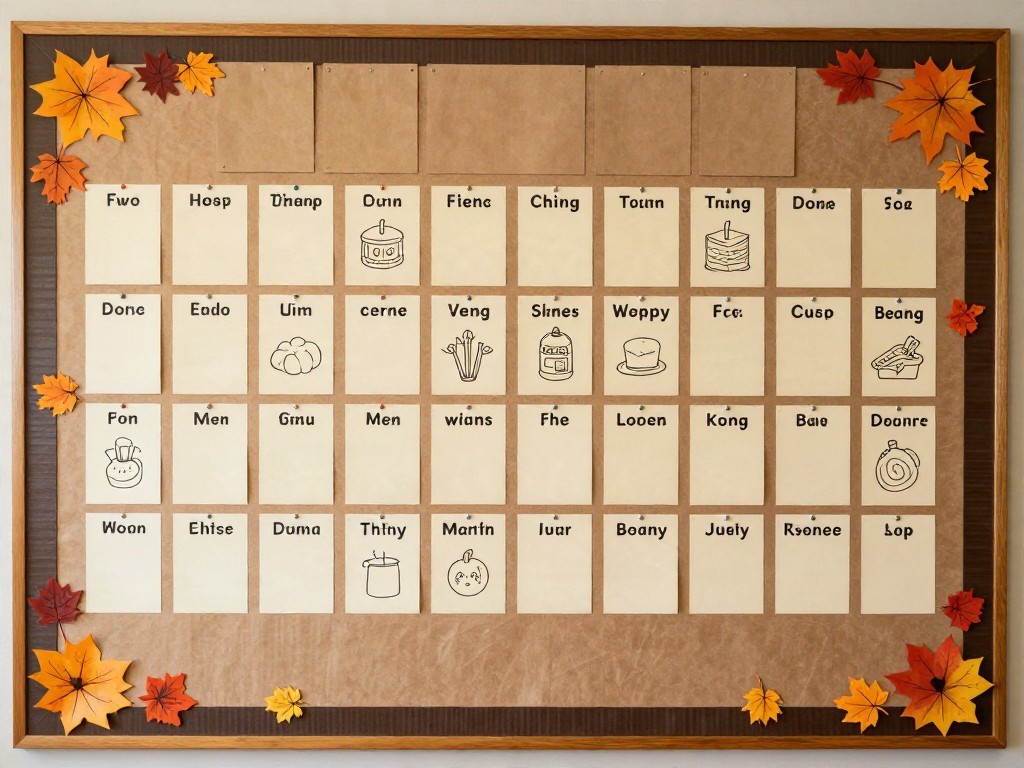
Two content areas show up repeatedly in the sources: math and vocabulary. A Thanksgiving word wall is the simplest vocabulary board. It features fall and Thanksgiving words such as harvest, gratitude, gather, and family, each with a picture or drawing. Students can add words they hear during discussions. The board works as a reference during seasonal writing assignments.
A math version is the "Pie-Chart of Thanks," where students divide a circle into slices representing categories of gratitude. This connects the holiday theme to fractions or data representation. A more interactive math board is "Feather Fractions," which uses a turkey body and movable feathers. Students remove feathers and place some in a numerator area and some in a denominator area, then write the fraction on a laminated whiteboard section. The sources describe attaching the turkey body with feathers tucked inside for easy removal, and using sticky tack or push pins depending on student needs.
A third option is a Thanksgiving trivia board with question and answer slides. Questions are stapled to the board with answers underneath, so students can flip up the question to check their knowledge. This is an interactive display that does not require student writing, which makes it useful for a quick assembly.
Choose the tie-in that matches a current unit. A word wall supports writing across the month. A fraction board supports a specific math unit but may need to come down when the unit ends. A trivia board is flexible and works as a filler or early-finisher activity. Keep the academic purpose visible in the title so the board reads as part of the curriculum rather than extra decoration. For a related seasonal project outside the classroom, the Thanksgiving table decor practical guide covers a different reader task: setting a table rather than building a wall display.
Tips
- Explain the board routine once, then let students use it independently.
- Refresh prompt boards weekly so the display stays current.
- Photograph finished boards as a record of student work and participation.
Whiteboard, Door, and Hallway Alternatives
When a full bulletin board is not available, the same Thanksgiving bulletin-board ideas for November can move to a whiteboard, a classroom door, or a hallway stretch. The sources treat these as legitimate display surfaces rather than compromises, and each one changes what you can realistically attach.
Whiteboard. Little Learning Corner suggests a simple prompt line — "Today I'm thankful for ___" — with borders made from magnetic tape and leaf cutouts held by magnets. This is the fastest option because nothing is stapled and everything can be repositioned. The trade-off is that marker writing smudges and magnets slide; keep the prompt short and let students add one leaf each rather than filling the whole surface.
Door. A door is a narrow vertical space, so a single tall element works better than a wide scene. A large turkey body with feathers added around it, or a stacked gratitude list, fits the shape. Avoid heavy 3D pieces that catch on the door swing or block the handle and window.
Hallway. The sources describe two hallway formats: a collaborative display built from every student's contribution, and an "Interactive Gratitude Graph" where students place a sticker in a category of thanks. The graph is the lower-prep choice and produces a visible tally you can read at a glance. A hallway board also reaches families and other classes, so a title that explains itself without a teacher present is worth the extra minute.
Choosing between them. Use the whiteboard when you want daily interaction and quick changes, the door when space is tight and the display is mostly decorative, and the hallway when the goal is a shared, student-built display. All three still need a clear title and a border to read as intentional rather than improvised.
Thanksgiving Bulletin Boards November: Whiteboard, Door, and Hallway Alternatives
When a full bulletin board is not available, the same Thanksgiving bulletin-board ideas for November can move to a whiteboard, a classroom door, or a hallway stretch. The sources treat these as legitimate display surfaces rather than compromises, and each one changes what you can realistically attach. For a related seasonal project outside the classroom, the Thanksgiving table decor practical guide covers a different reader task: setting a table rather than building a wall display.
Whiteboard. Little Learning Corner suggests a simple prompt line — "Today I'm thankful for ___" — with borders made from magnetic tape and leaf cutouts held by magnets. This is the fastest option because nothing is stapled and everything can be repositioned. The trade-off is that marker writing smudges and magnets slide; keep the prompt short and let students add one leaf each rather than filling the whole surface.
Door. A door is a narrow vertical space, so a single tall element works better than a wide scene. A large turkey body with feathers added around it, or a stacked gratitude list, fits the shape. Avoid heavy 3D pieces that catch on the door swing or block the handle and window.
Hallway. The sources describe two hallway formats: a collaborative display built from every student's contribution, and an "Interactive Gratitude Graph" where students place a sticker in a category of thanks. The graph is the lower-prep choice and produces a visible tally you can read at a glance. A hallway board also reaches families and other classes, so a title that explains itself without a teacher present is worth the extra minute.
Choosing between them. Use the whiteboard when you want daily interaction and quick changes, the door when space is tight and the display is mostly decorative, and the hallway when the goal is a shared, student-built display. All three still need a clear title and a border to read as intentional rather than improvised.
Quick-Assembly Titles and Sayings for Thanksgiving Bulletin Boards November
A title does most of the work on a Thanksgiving display, and the sources supply a ready list you can borrow rather than invent. Little Learning Corner's quick list includes "Gobble Up Good Books," "Our Thankful Turkeys," "Thankful Hearts, Helping Hands," "Gratitude Grows Here," "A Cornucopia of Kindness," "So Very Thankful," "Feast of Friendship," "We Are Thankful," and "Pie-Chart of Thanks." Elementary Nest adds "Fall Into a Good Book," "Our Top Class Books Harvest," "Spread Kindness, One Feather at a Time," "Feathers of Kindness," and "Thankful for Our Class." We Are Teachers offers "Thankful Gnome Matter What," "Look Whoooo's Thankful," and "Gobble Squad."
Match the title to the activity. A book-themed title only makes sense if students are posting book recommendations. "Pie-Chart of Thanks" signals a math tie-in, and the sources describe exactly that: students divide a circle into slices of gratitude categories. "Feathers of Kindness" pairs with a feather-writing activity, not a plain turkey cutout.
Keep it short. Titles that fit on one line at reading height are easier to letter by hand or arrange from cut letters. Long phrases force small lettering that disappears across a hallway.
Let students supply the words. For an interactive board, the title can be fixed while the content underneath changes — a prompt line plus student-written leaves, feathers, or cards. This keeps prep to one title and a stack of blanks.
Reuse the lettering. The sources recommend storing seasonal titles and borders together so next November's setup starts from a labeled envelope rather than a blank wall.