
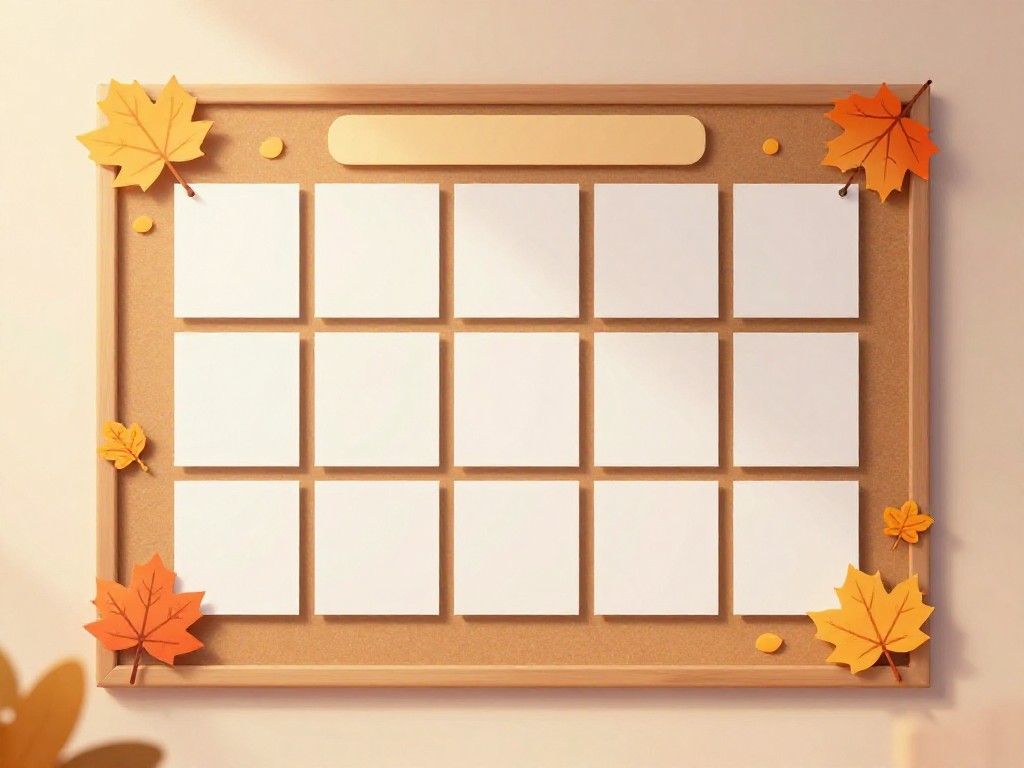
Fall bulletin board ideas for work succeed when the board has a clear job. The problem is rarely the theme. It is that the board was built to be looked at once. This planning guide walks through six decisions that keep a workplace board useful through the fall: diagnosing why seasonal boards go stale, naming the board's job, matching the format to that job, making participation inclusive, setting a refresh rhythm with one owner, and adapting the plan for clinic or hospital settings. No House of Small Makes physical project or product test has been recorded for this guide; it is a research-backed planning resource. If you want seasonal making inspiration for other spaces, see these fall craft ideas and this collection of simple fall decor ideas.
1. Why Workplace Fall Boards Go Stale
Seasonal boards often begin with a theme and end with decoration only. Once the novelty fades, nothing on the board asks anyone to return, so it becomes background. Deciding a purpose first prevents that.
A board that only announces "Happy Fall" gives a passerby no reason to stop on day twelve. A board that carries a deadline, a rotating photo, or a blank leaf waiting for someone's goal gives a reason to look again. The difference is not artistic skill. It is whether the board has a job.
This is why the planning order matters. Theme first leads to decoration. Job first leads to a display that happens to be seasonal. The remaining sections of this guide follow that order: purpose, format, participation, rhythm, and setting-specific adaptation.
Steps
- Write one sentence describing what a person should do after reading the board.
- If the sentence is only "feel festive," revise the board's purpose before buying supplies.
Tips
- Before buying anything, write one sentence describing what a person should do after reading the board.
- If the sentence is only "feel festive," the board will go stale quickly.
2. Name the Board's Job Before You Decorate
Workplace boards commonly serve one of a few jobs: sharing practical information such as events, deadlines, and meetings; supporting wellbeing with seasonal tips; or recognizing people through birthdays, goals, and achievements.
Write the job as a single sentence and tape it behind the board frame where only the maintainer sees it. Examples: "This board tells staff what is happening in October." "This board lets people post a goal and see it acknowledged." "This board shares autumn wellness tips people can use this week."
One job per board is the practical rule. A board trying to be an events calendar, a birthday wall, and a wellness display at once usually does none of them legibly. If your workplace needs all three, plan three zones or rotate the job month by month rather than stacking everything at once.
Steps
- Write the board's job as a single sentence.
- Tape the job sentence behind the board frame where only the maintainer sees it.
- If the board needs to serve multiple jobs, plan separate zones or rotate the job monthly.
Tips
- Keep the job sentence short enough to say out loud in one breath.
- If two people disagree about the job, that disagreement is the real planning problem, not the decorations.
3. Match the Format to the Job
Goal and harvest displays suit teams tracking progress. Gratitude trees and recipe or photo exchanges suit morale and connection. Event, wellness, birthday, and department-news layouts suit information-sharing. Book and reading displays work where staff or students pass a reading corner.
Match the format to the job rather than to the season. A harvest or cornucopia motif carries a goal-tracking board naturally because abundance and progress share a visual language. A gratitude tree carries connection because each leaf is a contribution. A clean grid of dates and headings carries information because grids read quickly.
Format also includes reading distance. A board in a corridor where people walk past needs large headings and few words. A board beside a break room table, where people stand and linger, can carry more detail. Choose the format for the viewing condition, not for the pinning session.
Materials
- Background paper or fabric in an autumn tone
- Leaf, pumpkin, or harvest-shaped cutouts for contribution slots
- Heading letters or printed title strip
- Pins, staples, or removable adhesive appropriate to the board surface
- Blank cards or slips for employee-submitted content
Steps
- Write the job sentence at the top of your planning notes.
- List the formats that fit that job from the options above.
- Choose the format that also fits the viewing distance and dwell time of the board's location.
- Sketch the layout on paper, including where submitted content will go.
- Only then choose colors and seasonal motifs that support the layout.
Tips
- If the board is passed at walking speed, cut the word count before cutting the font size.
- Leave at least one empty zone in the sketch for content you have not received yet.
4. Make It Participatory Without Leaving Anyone Out
Boards build community when people can add their own goals, updates, or photos rather than only reading a finished display. When showing work or answers, include every person rather than a select few, and keep the tone all-ages appropriate for a shared space.
Inclusion here is a design decision, not an afterthought. If the board has twenty slots and thirty employees, the format itself excludes people. Plan capacity to match the group, or rotate who appears so everyone cycles through. A recipe exchange, a photo wall, and a goal board all work this way: the board is a container, and the container must be big enough.
Tone matters in shared workplaces. Humor that reads as gentle in one team can read as pointed in a mixed lobby. Keep headings warm and neutral, and let the submitted content carry the personality.
Steps
- Name one owner and one backup by name, not by role title.
- Put the refresh date on the same calendar as an existing monthly meeting.
- At each refresh, remove outdated items, add new submissions, and photograph the board for the record.
- Keep a small supply box with pins, slips, and a marker stored near the board.
- Review at the end of the season whether the board's job was actually served.
Tips
- Count the people who could contribute, then count the slots. Adjust before pinning.
- Provide blank slips near the board so contributions do not require asking anyone.
- Review headings for anything that could read as a joke at someone's expense.
5. Plan the Refresh Rhythm and One Owner
Monthly updating is a common pattern for goal, news, and recognition boards, with space set aside for employee-submitted updates and a team or photo section so the board stays current through the fall months.
Monthly updating aligns with how workplace information often changes, though the right rhythm depends on your team. A single named owner is what keeps the rhythm alive; shared ownership without a name usually means no one refreshes it. The owner does not have to do all the work, but they hold the calendar and the key to the supply cabinet.
Build the refresh into an existing routine rather than creating a new one. If the team already meets monthly, the refresh belongs on that agenda. A short recurring task is easier to sustain than a special project.
Steps
- Name one owner and one backup by name, not by role title.
- Put the refresh date on the same calendar as an existing monthly meeting.
- At each refresh, remove outdated items, add new submissions, and photograph the board for the record.
- Keep a small supply box with pins, slips, and a marker stored near the board.
- Review at the end of the season whether the board's job was actually served.
Tips
- Photograph the board after each refresh so you can see what changed over the season.
- If the owner changes, hand over the job sentence along with the supplies.
6. Adapt the Plan for a Clinic or Hospital Setting
In healthcare workplaces, boards often sit in corridors, waiting areas, and labs. As a design recommendation, treat those spaces as quick-read environments: use fewer words, larger type, and a clear hierarchy of one heading, one message, one action. Seasonal motifs should support legibility rather than compete with it. A single leaf border and a strong heading may work better than a full harvest scene in a corridor where people are moving through.
Waiting areas are different from corridors. People there may sit for minutes, so a board can carry slightly more content, such as a short wellness tip or a rotating photo section. Even there, keep the seasonal decoration restrained and the practical content dominant. In a clinical setting, consider making the board's job to inform or to calm rather than to entertain.
Steps
- Test legibility by standing at the distance people actually pass the board.
- Keep the seasonal layer removable so the board can return to plain signage if needed.
- Avoid dense text blocks in corridors and labs; save detail for waiting areas.
Tips
- Test legibility by standing at the distance people actually pass the board.
- Keep the seasonal layer removable so the board can return to plain signage if needed.
- Avoid dense text blocks in corridors and labs; save detail for waiting areas.