
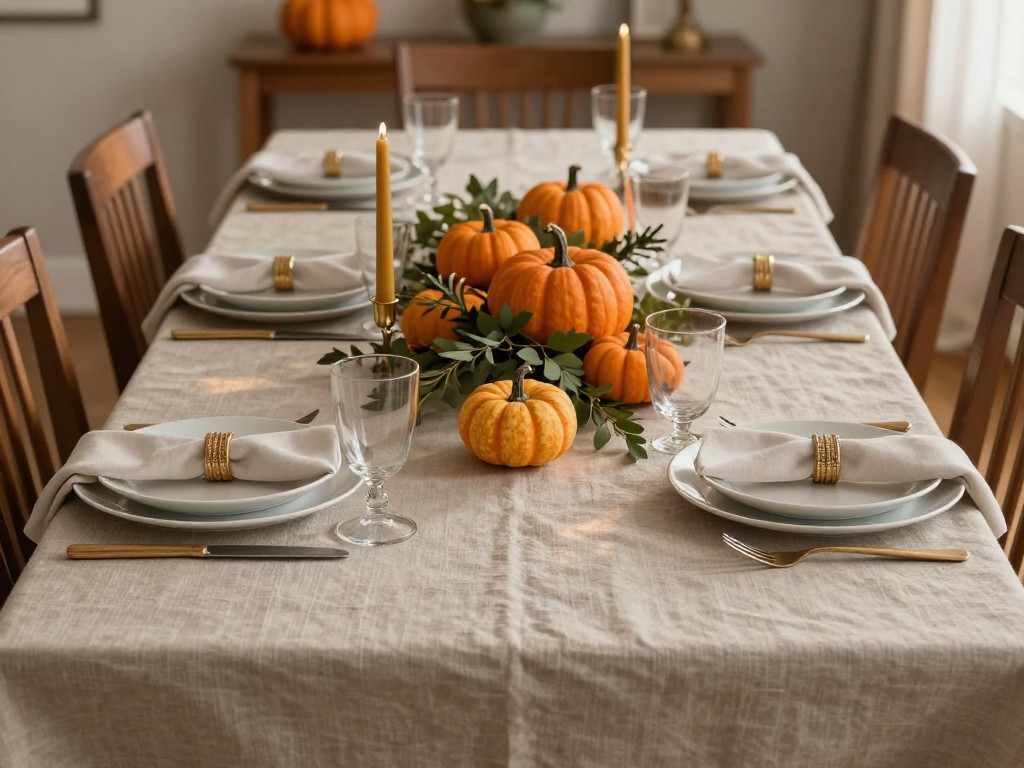
Thanksgiving table decor has to do something most tablescapes never attempt: hold a turkey, four or five sides, gravy, bread, wine, and water while seating more people than the table comfortably fits. The elaborate centerpiece that looked right on Wednesday often gets moved to the sideboard on Thursday because there is nowhere for the potatoes to go. This guide works through the decisions that keep a table beautiful and usable — seating math, color, linens, centerpiece height, place settings, candlelight, and the clear serving spine — so the decor survives the meal instead of competing with it. If you are still shaping the room around the table, these simple fall decor ideas for a calm, cozy home can help the dining room feel connected to the rest of the house.
Thanksgiving Table Decor: Start With the Table and Seating Plan
The first decor decision is not a color or a centerpiece — it is how many people will sit at the table and how much room each person gets. A common planning figure is 24 inches of table width per person. Count chairs against that number before you buy or borrow anything, because a table that seats eight comfortably can become a cramped ten once the serving dishes land.
Decide early whether the meal will be family style, with bowls passed at the table, or sideboard style, with food plated or served from a separate surface. That choice changes how much clear tabletop you need to protect. If you are serving family style, the center of the table is a working zone, not a display zone. If you are serving from a sideboard, you can afford a slightly fuller centerpiece because the bowls will not need to sit down.
Check your serving dishes at the same time. Count the bowls, platters, gravy boats, and bread baskets you actually own, then borrow rather than buy the gaps. A borrowed platter that fits the table is more useful than a new one that crowds it. This is also the moment to think about the room around the table: a small front porch display of pumpkins and mums can carry the seasonal welcome outside so the dining table does not have to do all the work.
A workable timeline starts a week ahead with the chair count and the serving-style decision. Two days ahead, wash and press linens and cut any branches, which open up indoors over about 48 hours. The day before, set the table completely and photograph it — problems show up in a photo that you cannot see standing over the table. On Thanksgiving morning, add fruit and foliage, fill water glasses, and leave the center spine clear.
Tips
- Measure table width and divide by 24 inches to estimate comfortable seating.
- Choose family style or sideboard style before you plan the centerpiece.
- Borrow serving dishes rather than buying pieces that crowd the table.
- Photograph the set table the day before to catch spacing problems.
Choose a Color Palette That Lets the Food Stand Out
The meal is already a warm palette: golden-brown turkey, orange squash, cranberry red, buttery corn, and deep gravy. If you add orange decoration on top of that, the whole surface turns into one undifferentiated warm mass where nothing reads clearly. The most useful color decision is to let the food supply the orange and give the table a cooler or more neutral ground for it to sit against.
That does not mean the table has to be brown and beige. Pale pinks, mustardy yellows, muted terra-cotta, ivory, cream, forest green, and soft neutrals all work because they leave room for the food to be the brightest thing on the table. A neutral palette also tends to last through the whole fall season rather than reading as a single-day theme. If you want a more modern look, bare wood or a single runner with one repeated material and low sculptural vessels can be enough; the warmth comes from candlelight and the food.
For a more formal table, formality comes from quality and repetition rather than quantity: proper linen, real glassware, tapers in slim holders, a side plate at every seat, and place cards. Gold accents can work when they are paired with natural materials and soft colors, but gold-sprayed decoration added just to achieve formality often reads as the opposite. Pick one metallic and repeat it in napkin rings, flatware, or candleholders rather than scattering several finishes.
A practical test is to look at the set table from a few feet back and ask what your eye lands on first. If the answer is a decorative object rather than the food or the people, the palette or the quantity of decor is probably doing too much. For more seasonal inspiration, these simple fall decor ideas for a calm, cozy home can help you carry the palette through the rest of the house.
Tips
- Let the food supply the orange; use cooler or neutral tones on the table.
- Repeat one metallic finish instead of mixing several.
- Choose a palette that can stay up through the fall, not just one day.
Lay the Foundation With Linens and a Runner
Linens are the easiest way to transform a dining table because they set the ground for everything else. Start with a neutral tablecloth or bare wood, then decide whether a runner earns its place. A neutral cloth can cover a scuffed table or combine two shorter tables for a crowd, while a bold runner adds visual interest and gives the tabletop some protection from hot serving dishes. The runner should be muted enough that it does not overpower the place settings.
Natural-looking textiles in warm neutrals, ivory, cream, or forest green are versatile choices that let pumpkins, flowers, candles, greenery, and gold tableware become the focal points. If you are using patterned napkins or a patterned runner, keep the other elements quiet so the table does not become busy.
Placemats are optional and depend on space. Round woven placemats take up less room than large chargers and can feel like a casual, colorful alternative when you are trying to make a table that usually seats six work for eight or more. If the table is already tight, skip placemats entirely and let the linen or wood show.
Wash and press linens two days ahead so wrinkles have time to relax and any ironing mistakes are not discovered on Thursday morning. If you are using a runner, check that it still leaves enough bare table at each place setting for a plate, glass, and flatware without hanging over the edge.
Tips
- Use a neutral cloth as the base and let a runner add interest.
- Choose round or smaller placemats when seating is tight.
- Press linens two days ahead rather than on the day.
Build a Low or Raised Centerpiece That Keeps Conversation Open
Centerpiece height is the decision that most affects whether people can talk across the table. The practical rule is either under 12 inches or over 30 inches. The band between those heights sits exactly at seated eye level and blocks conversation. Low bowls, short candles, and small vessels work below the line; tall thin tapers and raised arrangements work above it, as long as the base is narrow enough not to crowd the plates.
A low centerpiece is often more practical because guests can see and talk to one another across the table. Candles, small pumpkins, seasonal greenery, pinecones, fruit, and natural branches can all work. Dried flowers in a bowl, a simple eucalyptus spray, or a seasonal bouquet kept low are enough to finish the table without turning it into an arrangement that has to be moved.
If you want a raised centerpiece, keep it visually light and make sure it does not overlap the serving zone. A tall arrangement on a narrow base can work at the end of a long table or on a sideboard, but a wide raised arrangement in the middle of a crowded table will be shifted before the turkey is carved.
Cut branches two days ahead because they open up indoors over about 48 hours. Add fruit and foliage on Thanksgiving morning so they look fresh. Whatever you choose, test the sightline by sitting in a chair at the table and looking across — if you cannot see the person opposite, the centerpiece is in the wrong height band.
Tips
- Keep centerpieces under 12 inches or over 30 inches.
- Test the sightline by sitting at the table and looking across.
- Cut branches two days ahead; add fruit and foliage on the day.
Set Place Settings With Napkins, Rings, and Small Vessels
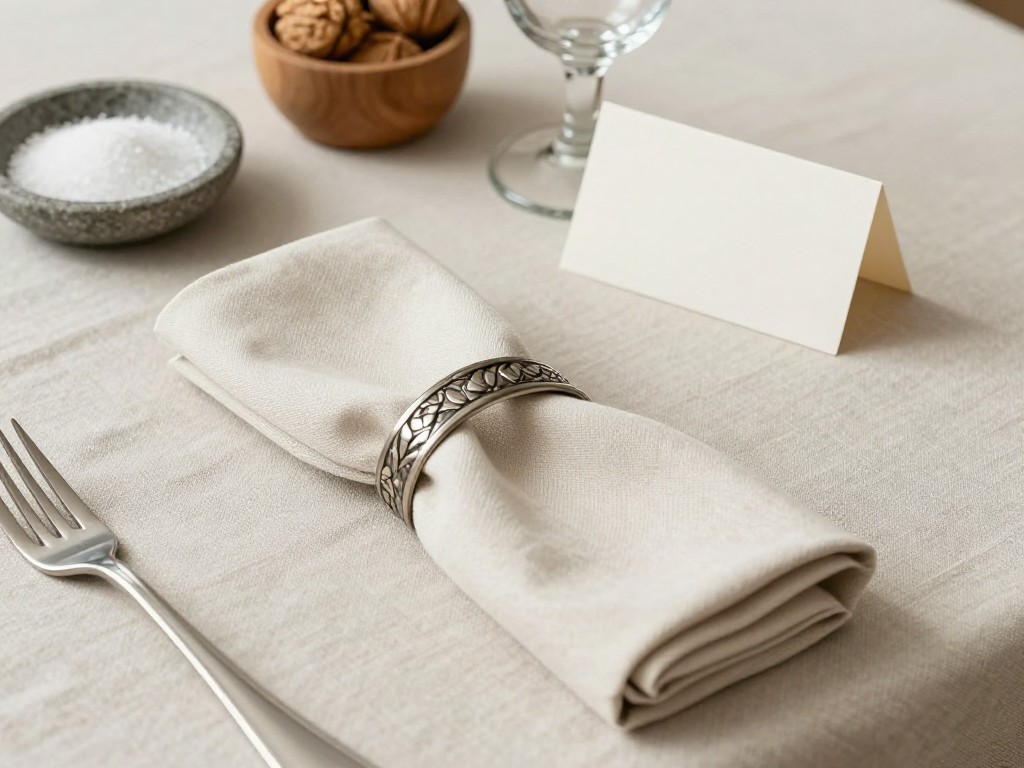
Place settings are where Thanksgiving table decor becomes personal. Fold each napkin simply rather than creating an elaborate fold, and let the napkin ring provide the decorative detail. A decorative napkin ring instantly polishes a place setting, and a single style repeated at every seat reads as intentional. If you are using place cards, something small to weigh them down — a shallow stone dish, a small vessel, or a natural object — keeps them from sliding.
The most useful objects on a Thanksgiving table are often the smallest: a shallow stone dish for flaky salt, a vessel for shelled walnuts, and something to hold place cards. All of them sit well under the sightline, and marble or terrazzo is a popular aesthetic choice for a cooler-looking ground against the food. Small vessels can also carry a few nuts or a single small flower at each setting without crowding the plate.
Flatware and glassware should be counted against the number of seats before the day. Real glassware and a side plate at every seat add formality through repetition rather than quantity. If you have a set of gold flatware or vintage amber goblets reserved for holidays, this is the meal to use them; a matching set reads more refined, while a mix of shapes and styles reads more eclectic.
Keep the place setting itself clear of clutter. A plate, flatware, one glass, a napkin, and one small vessel are usually enough. Anything more competes with the food and with the person sitting next to it.
Tips
- Fold napkins simply and let the ring be the detail.
- Use small shallow dishes for salt, nuts, and place cards.
- Count flatware and glassware against seats before the day.
Add Candlelight for the Afternoon-to-Evening Transition
Thanksgiving dinner in most of the United States starts in the afternoon and ends after dark. That transition is the single biggest thing happening to the table, and candles are what handle it. Candlelight matters more than flowers for this reason: it changes the room as the light fades, while flowers stay the same.
Light the candles about fifteen minutes before people sit down so the flames have settled and the wax has started to pool. Use stable holders that will not tip, keep flames clear of flammable materials like linen, napkins, and dried foliage, and keep them away from serving dishes that get passed. Never leave burning candles unattended, and extinguish them before guests leave or when you move to another room. Tapered candles in slim brass or metal holders fit a crowded table because they have a small footprint. Muted taper colors and fall-colored leaves at the base of the holders can tie them to the palette without adding bulk.
If you want scent as well as light, pumpkin spice candles can be lit in common areas and bathrooms before guests arrive so the warm scent carries through the home. Keep scented candles away from the dining table itself, where they can compete with the food.
Candles can also sit on the mantel or on accent tables, not only on the dining table. Spreading a few sources of warm light around the room makes the transition feel gradual rather than switched on at one table.
Tips
- Light candles about fifteen minutes before seating.
- Keep open flames away from passed serving dishes.
- Use slim taper holders to save table space.
- Keep scented candles in other rooms, not at the table.
Keep the Center Spine Clear for Serving Dishes
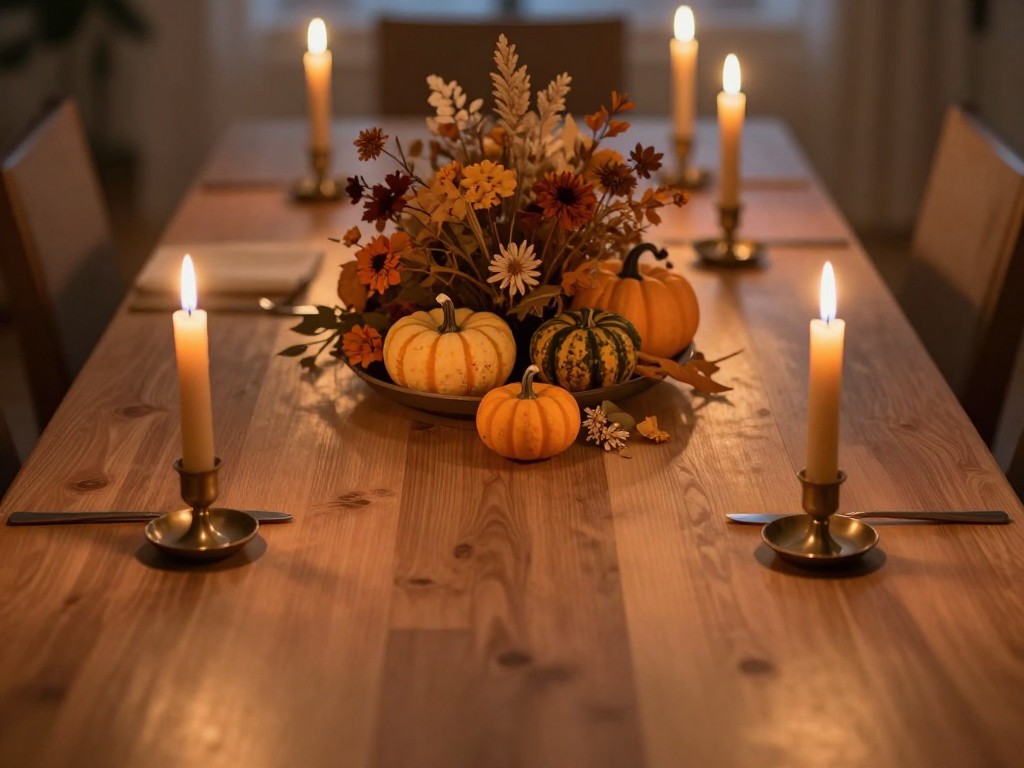
The center spine is the strip down the middle of the table where serving dishes will land. Leaving it clear is the single most practical rule for Thanksgiving table decor, because it is the difference between a table that works during the meal and one that has to be rearranged while people are already seated.
A Thanksgiving tablescape that survives the meal is designed around the serving constraint rather than in spite of it. If you are serving family style, plan for the turkey, four or five sides, gravy, bread, wine, and water to occupy the middle. That usually means keeping the centerpiece low and narrow, or moving it to a sideboard, and using the ends of the table for candles or small vessels rather than the center.
Clear serving dishes as they empty rather than at the end of the meal. A table that empties gradually stays pleasant to sit at, and it keeps the clear spine available for the next course. Between courses, consolidate rather than stack, and move empty dishes to the kitchen instead of leaving them on the table.
If you are hosting a larger gathering, the same principle applies here — keep the table's seasonal moment in one zone and leave the working space free. A small front porch display of pumpkins and mums can carry the seasonal welcome outside so the dining table does not have to do all the work.
Tips
- Leave the middle strip clear for serving dishes.
- Move the centerpiece to a sideboard if the table is tight.
- Clear dishes as they empty rather than at the end.
Plan a Simple Prep Timeline Before the Meal
A Thanksgiving table comes together best in stages rather than in one frantic hour on Thursday. The timeline below adapts the sequence published in a tablescape planning guide, which front-loads the decisions and leaves only small, low-risk touches for the morning of the meal. Treat the days as a working order, not a deadline — shift them earlier if your week is busy.
A week ahead: settle the layout. Count chairs against table width at roughly 24 inches per person, and decide whether food will be passed family-style or served from a sideboard. This is also the moment to check that you own enough serving dishes and to borrow rather than buy. If your table is tight, the fall decor ideas for a calm, cozy home can help you decide which pieces earn a place and which can move to a console or mantel.
Two days ahead: prepare textiles and branches. Wash and press linens so they are ready to lay flat, and cut any branches you plan to use — the same planning guide notes that cut branches open up indoors over about 48 hours, so cutting early gives them time to relax into shape.
The day before: set the whole table, then photograph it. A complete dry run lets you catch gaps while you still have time to fix them. The photograph matters: problems that are invisible when you stand over the table — a lopsided runner, a centerpiece crowding one seat, a missing glass — tend to show up clearly in a picture taken from a seated height.
Thanksgiving morning: add the perishable and fresh elements. Add fruit and foliage, fill water glasses, and confirm the center spine of the table is clear for serving dishes. Keep this stage small so it stays calm.
Fifteen minutes before guests sit: light the candles. Lighting early lets flames settle and wax begin to pool, which is the effect candlelight is there to create. Use stable holders, keep flames clear of flammable materials, and never leave burning candles unattended.
Between courses: clear as you go. Remove serving dishes as they empty rather than stacking everything at the end. A table that empties gradually stays pleasant to sit at through a long meal.
Two decisions are worth locking in during the week-ahead step because they affect everything after. First, centerpiece height: keep arrangements either under about 12 inches or over about 30 inches, since the band between those heights sits at seated eye level and blocks conversation. Second, color: let the food supply the orange, and lean on cooler or more neutral tones for linens and vessels so the turkey, squash, and cranberry read clearly against the table rather than blending into one warm mass.
If you are also dressing the entry guests pass through, the small front porch pumpkin and mum display follows the same logic — a few deliberate pieces placed early beat a last-minute scramble.
What you should not do: leave the entire setup for Thursday morning, buy new serving ware you will use once, or add decorations that crowd the serving zone. The observable outcome of a good timeline is a table that is fully set the day before, needs only fresh touches and candlelight on the day, and still has clear space for the food when it arrives.